
Running Facebook ads can be one of the most practical ways for a small business to reach potential customers online. But simply creating an ad, choosing a few interests, and adding a budget does not guarantee results.
A successful Facebook advertising campaign starts with a clear business goal. You need to know who you want to reach, what you want them to do, what offer you are presenting, and how you will measure whether the campaign is actually working.
The good news is that you do not need a huge marketing team to get started. With the right strategy, a small business can build, launch, and improve Facebook ad campaigns step by step.
In this guide, you will learn how to run Facebook ads for a small business, from choosing your objective and audience to setting a budget, creating your ad, tracking performance, and optimizing your campaigns.
Why Facebook Ads Can Be Useful for Small Businesses
Facebook ads are useful because they allow businesses to promote their products or services to specific audiences instead of relying entirely on organic reach.
For example, a local salon may want to reach people within a certain area, while an online store may want to reach people interested in a particular type of product.
Depending on the campaign and business goal, advertising can help you:
- Generate leads
- Drive traffic to your website
- Promote products
- Generate sales
- Receive messages or inquiries
- Build awareness
- Reach new potential customers
- Reconnect with people who have already interacted with your business
The important part is choosing an advertising strategy that matches the actual goal of your business.
Before You Start: Define Your Advertising Goal
Before opening Ads Manager, answer one simple question:
What do I want people to do after seeing my ad?
Your answer could be:
- Buy a product
- Submit a lead form
- Visit your website
- Send a message
- Learn about your business
- Engage with your content
For example, if you own a clothing store and want people to purchase products from your website, your campaign should be built around sales or conversions rather than simply trying to generate likes.
Likewise, if you are a local service provider who wants potential customers to contact you, a lead or messaging-focused campaign may make more sense.
A clear goal makes the rest of your campaign much easier to plan.
Set Up the Essentials
Before launching your first campaign, make sure the basic pieces of your advertising system are ready.
Facebook Page
Your business should have a properly completed Facebook Page with accurate business information, branding, contact details, and relevant content.
Your ads should lead people to a business presence that looks trustworthy. An excellent ad cannot completely compensate for a poorly maintained business page or website.
Meta Ads Manager
Meta Ads Manager is where you create and manage your advertising campaigns.
It allows you to control important parts of your campaign, including your objective, audience, budget, placements, creative, and performance tracking.
Payment Method
You also need an appropriate payment method connected to your advertising account so that your campaigns can run.
Website or Landing Page
If your goal is to generate website sales or leads, make sure the destination page is ready before launching the campaign.
A common mistake is sending paid traffic to a slow, confusing, or poorly designed page. If the ad gets people interested but the landing page fails to convince them, the advertising campaign can still struggle.
Tracking
For website-based campaigns, make sure your tracking setup is working before you start spending significant amounts.
Without reliable tracking, it becomes much harder to understand which campaigns and ads are producing meaningful business results.
Choose the Right Facebook Ads Campaign Objective
One of the most important decisions is choosing an objective that matches your business goal.
Do not choose an objective simply because it appears cheap or because it generates a large number of actions.
For example:
| Business Goal | Suitable Direction |
|---|---|
| Get people to visit your website | Traffic |
| Generate potential customer inquiries | Leads |
| Sell products online | Sales |
| Encourage interaction with content | Engagement |
| Introduce your business to more people | Awareness |
The exact options and campaign setup available in Meta can change over time, so always check the current Ads Manager interface when creating a campaign.
The principle, however, remains simple: optimize the campaign around the action that matters to your business.
Define Your Target Audience
Even a well-designed ad can perform poorly if it reaches the wrong people.
Your audience should be based on who is realistically likely to become your customer.
Depending on the business, you may consider factors such as:
- Location
- Age
- Gender where relevant
- Interests
- Existing customers
- Website visitors
- Previous interactions with your business
- Other relevant audience signals
Location Targeting
Location is particularly important for local businesses.
If you operate a restaurant, salon, clinic, repair service, or another location-dependent business, there is usually little value in paying to reach people who cannot realistically become customers.
A local business might therefore focus its advertising around its service area rather than targeting an entire country.
Interest Targeting
Interests can sometimes help you reach people who are relevant to your offer.
For example, a business selling fitness products may consider audiences related to fitness, exercise, or specific relevant interests.
However, do not assume that adding dozens of interests automatically creates a better audience.
The quality of your offer, creative, and overall campaign strategy also matters.
Custom and Lookalike Audiences
If your business already has useful customer or website data, you may be able to build audiences based on people who have previously interacted with your business.
Custom Audiences can help you reach existing or previously engaged users, while Lookalike Audiences can help you find people who resemble an existing audience.
Meta has historically provided these types of audience options, although the exact availability and setup can change with platform updates. (Facebook)
Decide Your Facebook Ads Budget
There is no universal Facebook ads budget that works for every small business.
Your budget depends on factors such as:
- Your business model
- Product or service price
- Audience size
- Advertising objective
- Competition
- Expected customer value
- Available marketing budget
If you are testing a new campaign, the goal should not necessarily be to spend as much as possible.
Instead, use a budget that gives the campaign enough room to collect useful data while remaining financially comfortable for the business.
You can use either a daily or lifetime budget depending on your campaign setup and requirements.
More importantly, do not judge a campaign simply by how much money it has spent.
A campaign that spends more but generates valuable customers may be much better than a campaign that spends very little but produces no meaningful business outcome.
Create an Ad That Gets Attention
Your targeting can be excellent, but people still need a reason to stop scrolling and pay attention.
A strong Facebook ad usually combines:
- A clear offer
- Relevant creative
- Simple messaging
- A strong value proposition
- A clear call to action
Writing the Ad Copy
Do not try to explain everything about your business in one ad.
Instead, focus on the problem, benefit, offer, or reason the customer should care.
For example, instead of:
We are a professional digital marketing company providing many different services.
You could communicate something more specific:
Struggling to generate consistent leads from Facebook? Get a campaign built around your target audience, offer, and business goals.
The second message gives the reader a clearer reason to continue.
Choosing the Creative
Your creative could be:
- An image
- A video
- A carousel
- Another format supported by your campaign
The creative should match the offer and audience.
For many businesses, testing different creative concepts can reveal what catches attention and generates meaningful actions.
Add a Clear Call to Action
Tell the audience what you want them to do next.
Depending on your campaign, that could be:
- Shop Now
- Learn More
- Sign Up
- Contact Us
- Send Message
- Get Quote
Avoid making the customer guess what happens after they click.
Launch Your First Campaign
Once your strategy is ready, you can build the campaign inside Meta Ads Manager.
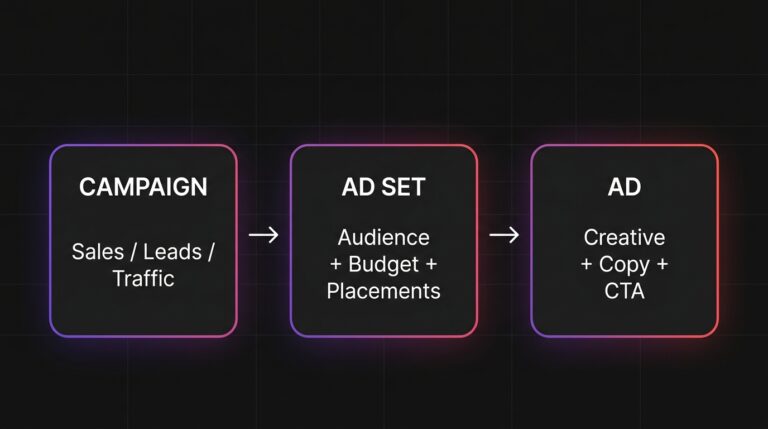
The general structure looks like this:
Campaign → Ad Set → Ad
At the campaign level, you establish the overall campaign direction and objective.
At the ad set level, you typically manage things such as audience, budget, schedule, and placements.
At the ad level, you create the actual advertisement that people will see.
A Simple Launch Process
- Create a new campaign.
- Select the objective that matches your business goal.
- Configure the relevant campaign settings.
- Define your target audience.
- Set your budget and schedule.
- Review your placements and other available settings.
- Create your ad creative and copy.
- Add the appropriate destination.
- Review everything carefully.
- Publish the campaign.
Do not rush through the review stage.
Check your spelling, links, offer, targeting, budget, creative, and tracking before spending money.
Track the Right Metrics
Once your campaign is running, you need to know whether it is producing meaningful results.
Some common advertising metrics include:
| Metric | What It Tells You |
|---|---|
| Reach | How many unique people saw your ad |
| Impressions | How many times your ad was shown |
| CTR | How often people clicked after seeing the ad |
| CPC | Average cost per click |
| CPM | Cost per 1,000 impressions |
| Leads | Number of leads generated |
| CPL | Average cost per lead |
| Conversions | Number of desired actions completed |
| CPA | Average cost per acquisition/action |
| ROAS | Revenue generated relative to ad spend |
The most important metric depends on your objective.
For an e-commerce campaign, purchases and return on ad spend may matter more than clicks.
For a lead generation campaign, qualified leads and cost per lead may be more important.
For an awareness campaign, reach and impressions may have more relevance.
Do not judge every campaign using the same metric.
Optimize Your Facebook Ads
Launching a campaign is not the end of the process.
Once you have enough meaningful data, look for patterns.
Ask questions such as:
- Which creative is getting better engagement?
- Which audience is producing better results?
- Are people clicking but failing to convert?
- Is the offer attractive enough?
- Is the landing page creating friction?
- Is the cost per result sustainable?
- Are some ads clearly underperforming?
You can then make informed adjustments.
Test Your Creatives
If one creative consistently performs better than another, investigate why.
Perhaps the message is clearer, the visual is stronger, or the offer is easier to understand.
Use those insights when developing your next creatives.
Test Your Audiences
Different audiences can respond differently to the same offer.
Testing relevant audience groups can help you understand where your strongest potential customers are.
Do Not Change Everything at Once
If you change the audience, creative, budget, offer, landing page, and campaign settings simultaneously, it becomes difficult to understand what actually caused the performance change.
Make thoughtful changes and compare the results.
Testing and optimization are ongoing parts of advertising rather than one-time tasks.
Common Facebook Ads Mistakes Small Businesses Should Avoid
Many advertising problems come from strategy rather than the advertising platform itself.
Here are some common mistakes to avoid.
1. Running Ads Without a Clear Goal
If you do not know what success looks like, you cannot properly evaluate your campaign.
2. Targeting Everyone
A larger audience is not automatically a better audience.
Your targeting should make sense for your product, service, location, and customer.
3. Using a Weak Offer
People need a reason to take action.
If your offer is unclear or does not provide enough value, better targeting alone may not solve the problem.
4. Using Poor Creative
A generic image and vague message can make it difficult to capture attention.
5. Ignoring the Landing Page
If people click your ad but encounter a confusing or slow website, your advertising performance can suffer.
6. Measuring Likes Instead of Business Results
Likes and comments can be useful signals, but they are not necessarily the outcome your business needs.
A campaign generating fewer likes but more qualified leads may be far more valuable.
7. Making Changes Too Quickly
Constantly editing a campaign without enough information can make it difficult to understand what is actually working.
8. Scaling Before Understanding the Campaign
Increasing the budget simply because an ad received some positive results is not always the right move.
First understand whether the results are consistent and financially valuable for the business.
When Should You Hire a Facebook Ads Specialist?
Managing Facebook ads yourself can make sense when you are learning, testing a small campaign, or have enough time to understand the platform.
However, professional help can become valuable when:
- You do not have time to manage campaigns
- Your campaigns repeatedly produce poor results
- You are unsure how to structure campaigns
- Tracking is difficult to configure
- You are spending a meaningful amount on advertising
- You need regular testing and optimization
- You want to focus on running the business instead of managing advertising
The goal is not simply to have someone “run ads.”
The right specialist should understand the relationship between the offer, audience, creative, campaign objective, landing page, tracking, and business outcome.
Final Thoughts
Learning how to run Facebook ads for a small business is not just about pressing the Publish button in Ads Manager.
A successful campaign starts with a clear goal and continues with the right audience, a relevant offer, strong creative, an appropriate budget, reliable tracking, and ongoing optimization.
If you are just getting started, keep your first campaign focused. Do not try to test every possible audience, creative, and strategy at once.
Start with a clear objective, understand your customer, launch a well-structured campaign, monitor the right metrics, and use the data to make better decisions.
Over time, this process can help you build a much more reliable Facebook advertising strategy for your small business.
Frequently Asked Questions
How much should a small business spend on Facebook ads?
There is no single budget that works for every business. Your starting budget should depend on your business model, objective, audience, product or service value, and available marketing budget. Start with an amount you can comfortably use for testing and learning rather than assuming that a larger budget automatically means better results.
Are Facebook ads worth it for small businesses?
They can be, but the results depend on factors such as your offer, audience, creative, campaign objective, landing page, tracking, and optimization. Facebook ads are a marketing tool, not a guarantee of sales.
Can I run Facebook ads without a website?
Yes, depending on your campaign goal. Some campaigns can focus on actions such as leads or messages rather than sending people to a website. The best approach depends on what you want potential customers to do.
What is the best audience for Facebook ads?
There is no universally best audience. The right audience depends on your business, offer, location, customer profile, and available data. Existing customer data can also provide useful opportunities for audience building.
How long should I run a Facebook ad before changing it?
There is no universal number of days that applies to every campaign. Give the campaign enough opportunity to collect meaningful data, then evaluate performance against your actual business goal. Avoid making constant changes simply because you have not seen immediate results.
Should a small business run Facebook and Instagram ads together?
Depending on the campaign and available placements, advertising across Meta’s platforms can be useful. The important thing is to evaluate performance based on the results that matter to your business rather than assuming one placement will always be better.
Should I hire someone to manage Facebook ads?
If you have the time and want to learn, you can manage your own campaigns. If advertising is taking too much of your time, your campaigns are underperforming, or you need more advanced testing and optimization, working with an experienced specialist may make sense.
Need help with Facebook Ads for your business?
If you want to build, manage, or optimize a Facebook advertising campaign around your actual business goals, you can explore my Digital Marketing services or get in touch to discuss your requirements.
Note: Meta’s advertising interface, campaign options, targeting capabilities, and policies can change over time. Always check the current Ads Manager interface and official Meta documentation when setting up a live campaign. (Facebook)

2 comments
fdadsfa
oh my god